
Recovery

Find out more about our Recovery Best Practice
disabled-young-african-american-man-sitting-in-whe-2023-11-27-05-09-01-utc

Measure

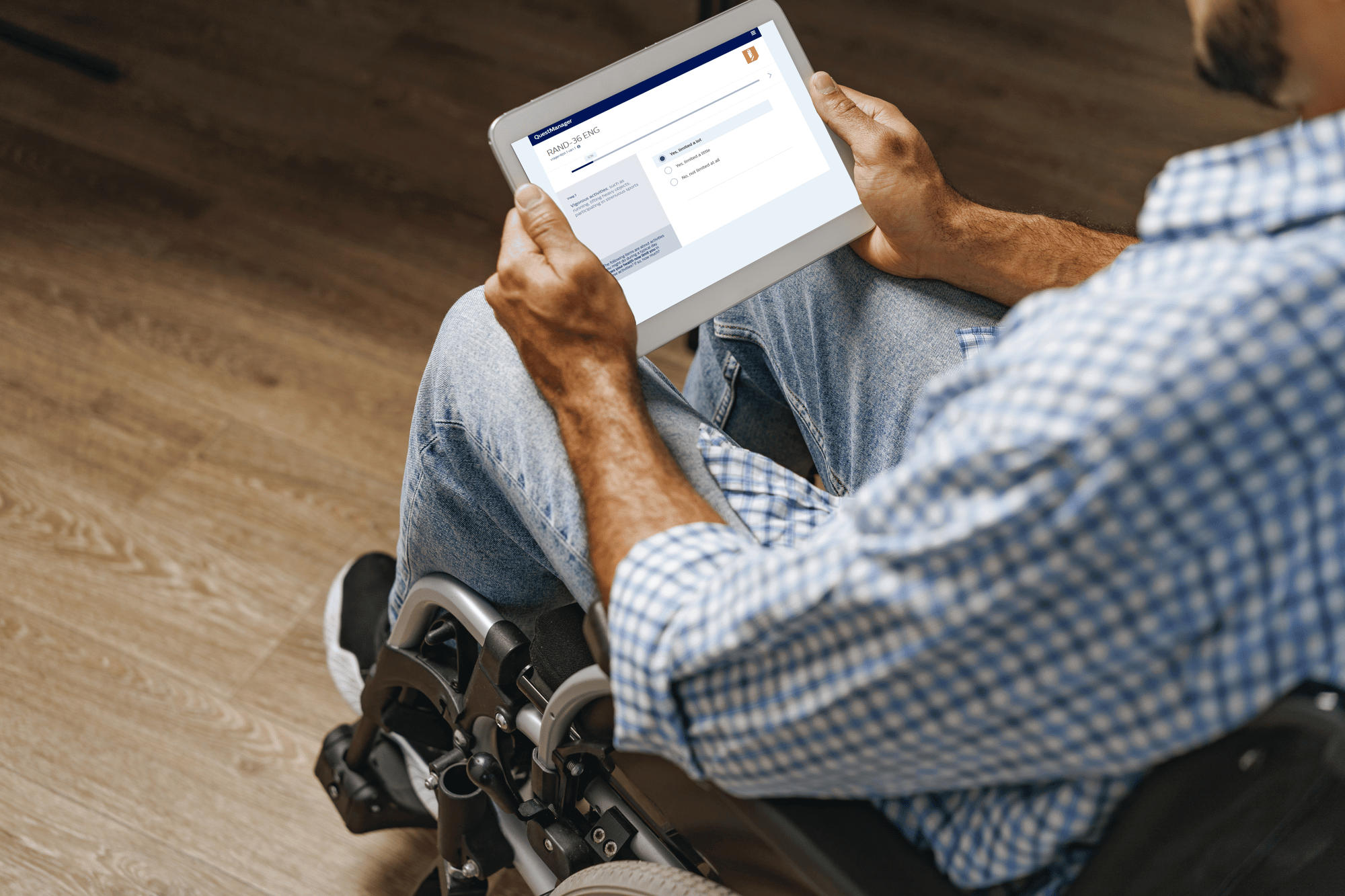
QuestManager supports rehabilitation processes with structured and phase-dependent measurements. Rehabilitators easily complete questionnaires at home or on site, allowing practitioners to continuously monitor physical, cognitive and emotional recovery.

Insight

With flexible measurement trajectories and validated instruments, valuable information is gathered about progress, load capacity and functioning. These insights are directly applicable in treatment plans and essential for evaluation and quality improvement within the rehabilitation team.

Better collaboration

Through shared dashboards, all disciplines work with the same up-to-date data. This strengthens multidisciplinary coordination, supports joint decision-making and makes progress transparent to rehabilitation patients and their networks.

Individual recovery goals

Rehabilitation requires accurate insights, smart work processes and treatment pathways that seamlessly align with care recipients' individual recovery goals. QuestManager supports rehabilitation centers with a fully configurable solution that advances both the care team and the care recipient.

Our software aligns with daily practice: flexible enough to fit the diversity of rehabilitation processes, and powerful enough to deliver complete, reliable data that can be applied directly to treatment decisions.

Why QuestManager in rehabilitation?

Personalized measurement trajectories.

Tailor measurements to the stage of recovery. From intake to discharge: QuestManager schedules, sends and processes questionnaires automatically so that progress is easily and consistently monitored.

Complete picture of recovery

With (effectiveness) measurements, PROMs and qualitative evaluations, the treatment team gains accurate insight into physical, functional and psychosocial recovery. This forms the basis for informed treatment choices.

Remote monitoring

Caregivers complete questionnaires at home, via mobile or computer. This keeps the treatment team continuously informed between consultations, even in long-term rehabilitation processes.

Collaboration within the multidisciplinary team

The results are clearly displayed in dashboards relevant to each discipline. All professionals involved work with the same up-to-date information, making coordination easier and faster.

Insight that motivates

Caregivers can track their own progress through easy-to-understand reports. This supports motivation, engagement and adherence - important factors in recovery.

What does it give your rehabilitation center?

  • Consistent data collection through validated and proprietary questionnaires

  • More time for treatment, less manual administration

  • Faster identification of abnormal outcomes or risks

  • Flexible integrations with EHRs and existing IT systems

  • Better treatment outcomes through data-driven choices and personalized care

Rehabilitation with more insight, less effort

QuestManager supports rehabilitation centers in optimizing their care processes and delivering high quality, person-centered care.

From orthopedic rehabilitation to chronic pathways: the software moves with the needs of your organization and your patients.

Cases

Learn how rehabilitation centers are using QuestManager in their treatment processes. In the customer cases below, read how multidisciplinary teams, rehabilitation patients and loved ones are working together on recovery using structured measurements, smart dashboards and data-driven treatment decisions.
Neurorehabilitation

Daan Theeuwes Center

Data-driven neurorehabilitation with QuestManager

  • Monitoring progress with more than 70 clinical measurements

  • Multidisciplinary dashboards for insight into physical, cognitive and emotional recovery

  • High response rate (87%) thanks to structured measurement street (MFS)

  • Data as basis for prediction models, precision medicine and care innovation

Recovery

Improved treatment outcomes with patient-centered PROM monitoring

  • Systematically measure quality of life, functioning, pain and participation

  • Outcomes directly visible to clinicians for timely adjustment

  • Follow-up trajectories for both adults and children (including smiley questionnaires)

  • Data used for treatment optimization and scientific research